
How Small Business Owners Can Use AI Without Losing the Human Touch
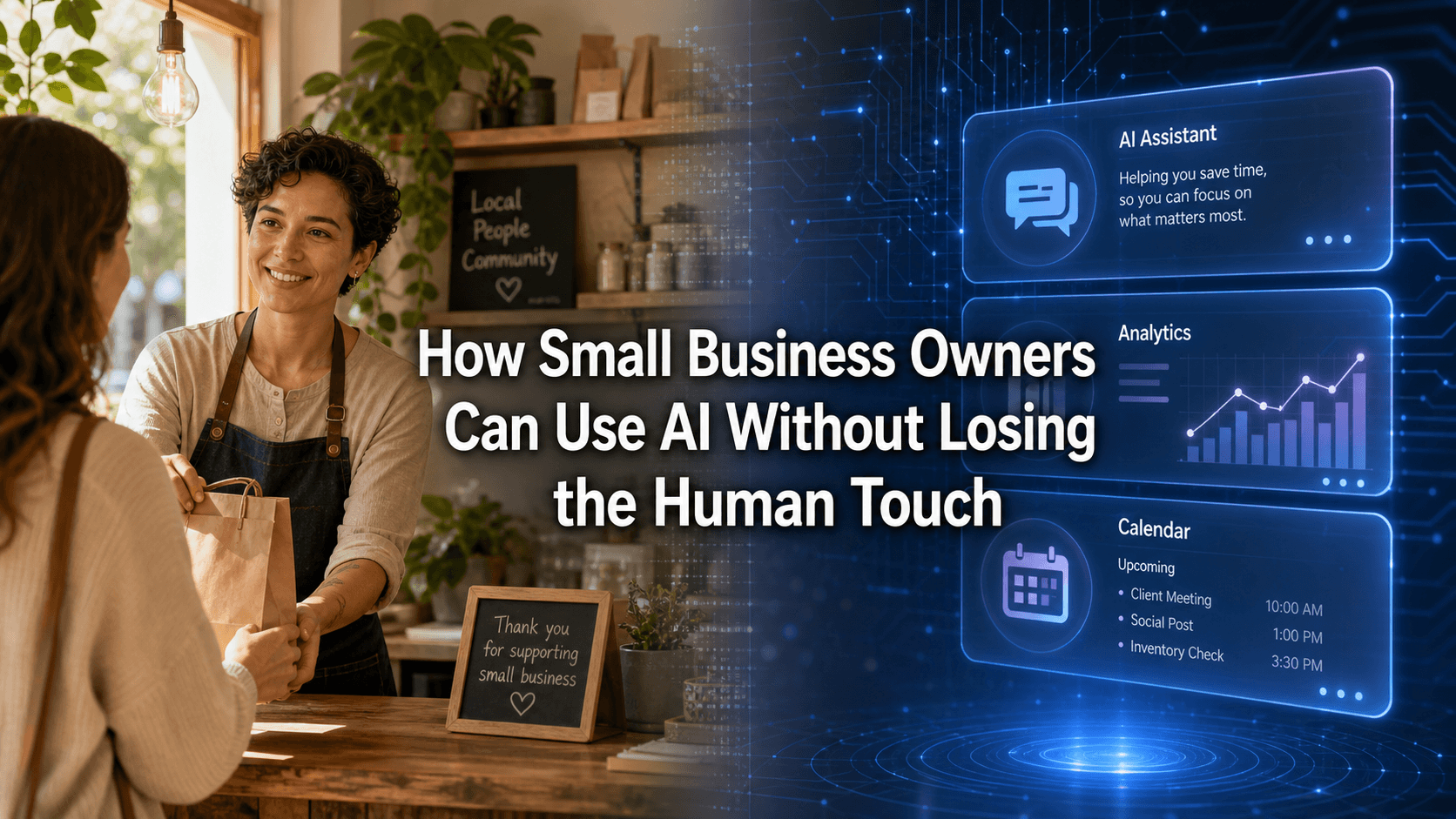 "How Small Business Owners Can Use AI Without Losing the Human Touch")
Artificial intelligence is no longer just something used by big corporates with giant tech budgets.
More Australian small businesses are now using AI through tools such as ChatGPT, Google Gemini, Claude and Microsoft Copilot to automate tasks, improve customer experience and work more efficiently.
At the same time, government guidance is clear that businesses need to use these tools thoughtfully, especially where privacy, security and trust are involved.
For many small business owners, that creates a tension.
On one hand, AI can save time.
On the other, your business probably grows because people trust you, remember you, and feel looked after by you.
If AI starts making your business feel generic, robotic or impersonal, it can quietly weaken the very thing that makes local businesses special.
The good news is this: AI works best when it supports relationships rather than replaces them.
Use AI for speed, not for soul
A simple rule of thumb is to let AI handle the first draft, the admin load, and the repetitive tasks, while you keep control of the parts that need judgement, empathy and personality.
That means AI can help you:
- draft email replies
- summarise meeting notes
- turn rough ideas into social posts
- brainstorm blog topics
- create a first version of a proposal
- organise information quickly
But it should not become your substitute for:
- building trust
- understanding nuance
- handling difficult client conversations
- giving sensitive advice
- representing your values and tone without review
Customers can usually feel the difference between a message that was polished by a human and one that was simply pushed out by a machine.
1. Use AI to prepare for conversations, not replace them
If you attend networking meetings, sales calls, discovery sessions or referral conversations, AI can be a great preparation tool.
For example, you can ask it to help you:
- organise your talking points
- sharpen your elevator pitch
- prepare questions for a prospect
- summarise a client brief
- turn scattered ideas into a clean meeting agenda
That saves time and helps you show up more confidently.
But when the conversation begins, be present.
Listen. Ask follow-up questions. Read the room. That part is still human work — and it is often the part that wins business.
2. Let AI support your follow-up process
A lot of business owners are actually quite good at networking, but inconsistent at following up.
That is where AI can quietly become useful.
After a networking event, you can use AI to help draft:
- a warm follow-up email
- a LinkedIn message
- a referral introduction
- a “great to meet you” note
- a short recap of next steps
The trick is not to send the draft untouched. Add the detail that proves you were paying attention.
Mention the person’s business challenge. Refer to something they said over coffee. Tie your message back to the real conversation. That one minute of personalisation is what keeps the message human.
3. Use AI to turn your expertise into helpful content
Many small business owners already know enough to create excellent content. The problem is not knowledge. It is time.
AI can help you turn your existing expertise into:
- blog articles
- FAQs
- newsletter content
- educational posts
- customer guides
- checklists and templates
This matters because Google’s own guidance on AI search features still points site owners back to the same core principle: create helpful, reliable, people-first content that is genuinely useful.
It also recommends making important content available in clear text, supported by strong site structure and solid SEO fundamentals.
So if you are a mortgage broker, physio, plumber, accountant, coach, marketer or wellness practitioner, the opportunity is not to publish more fluff. It is to use AI to help you publish more of what you already know in a clear and useful way.
4. Keep your voice, examples and opinions
One of the biggest mistakes small businesses make with AI is publishing content that could have been written by anyone.
Generic wording does not build trust.
What builds trust is being specific, topic relevant and being human:
- the real questions customers ask
- the mistakes you see every week
- the local issues your clients face
- the practical advice you give in real conversations
- your actual point of view
AI can help you structure and refine those ideas, but the raw material should still come from your own experience.
If you want your business to sound like your business, feed AI with your insights, thoughts and style — not the other way around.
5. Use AI to reduce admin friction behind the scenes
Some of the best uses of AI are invisible to the customer.
Think about all the small tasks that chip away at your week:
- rewriting the same emails
- organising notes
- drafting standard responses
- summarising long documents
- creating first-pass marketing copy
- formatting training material
- turning recorded ideas into usable text
Used well, AI can reduce that admin load and free up more energy for the work that actually grows your business: service, relationships, follow-up and delivery.
That is where the human touch becomes stronger, not weaker.
6. Be careful in high-trust or sensitive situations
Government guidance for Australian small businesses stresses that AI tools can create risks around privacy, reliability and manipulated or inaccurate outputs.
It recommends human oversight, especially in higher-risk situations, and warns businesses not to upload sensitive information without proper safeguards.
In practice, that means you should be especially careful when using AI in areas involving:
- health information
- financial records
- legal matters
- staff issues
- confidential client data
- strategic business information
If the topic is sensitive, regulated or high-impact, AI should assist a qualified human — not replace one.
7. Make AI part of your business, not your personality
Your clients do not usually care whether you used AI to help draft a blog, create a checklist or structure an email.
They care whether your business feels trustworthy, helpful and competent.
That is the real benchmark.
Used badly, AI makes a business feel lazy and generic.
Used well, AI makes a business feel more responsive, more organised and more useful.
That is the sweet spot.
Final thought
The future for small business is not “AI versus people.”
It is AI handling the repetitive work so people can do more of the meaningful work.
If you are part of a strong business network, this becomes even more powerful.
You can use AI to save time, but still build your reputation the old-fashioned way: through trust, consistency, service and real relationships.
That combination is hard to beat.
Want to grow your business through genuine relationships, quality referrals and practical ideas you can actually use? ExploreLocal Business Networking and connect with local business owners who believe growth still starts with people.
| Tags:Business GrowthAI |